
FUNCTIONAL-LEVEL CHALLENGES

Where Business Requirements Become Organizational Capability.
A business determines what it must accomplish. Its functions must supply the specialized capabilities required to make those requirements executable.
Engineering, executive leadership, finance, human resources, manufacturing, operations, quality, sales, customer experience, supply chain, procurement, and other disciplines carry responsibilities upon which the wider organization depends. Their performance cannot be evaluated solely by whether individual departments remain active, complete assigned work, or achieve measures defined within their own organizational boundaries.
A function must be capable of producing the result the business requires, exercising the authority associated with its responsibilities, controlling the work within its jurisdiction, and coordinating effectively with the functions that provide its inputs or depend upon its outputs.
When functional capability falls below the requirements of the business, the consequences may appear as delayed decisions, recurring quality failures, unstable schedules, excess cost, poor customer performance, workforce strain, unreliable information, inventory distortion, margin deterioration, or operational work that repeatedly requires intervention.
TJEG works with owners, executives, functional leaders, and management teams when a matter involves the capability, structure, authority, coordination, control, or performance of a specialized organizational function.
Functional Strategy · Specialized Capability · Authority · Resources · Management Systems · Cross-Functional Coordination · Performance Control · Business Requirement Alignment
WHAT IS THE FUNCTIONAL LEVEL?
The Functional Level is where specialized organizational capabilities are established, governed, and coordinated.
At this level, business requirements are translated into functional responsibilities, professional disciplines, management systems, processes, resources, controls, information, decision rights, and coordinated organizational capability.
The Corporate Level establishes enterprise direction, governance, and structural authority. The Business Level determines how the organization will create value, compete, grow, and perform. The Functional Level determines what each specialized part of the organization must contribute and what capability is required to make that contribution reliable. The Operational Level applies those capabilities through the daily execution and control of work.
Functional Level responsibility may reside with:
C-suite executives responsible for a professional discipline
Vice presidents and functional directors
Department and division leaders
Plant, site, and regional leaders
Functional managers and process owners
Engineering, quality, financial, commercial, operational, and technical authorities
Shared-services leaders
Senior professionals responsible for specialized organizational capability
Not every organization separates its functions into formally established departments.
In a smaller company, one person may carry responsibility for several functions. An owner may simultaneously oversee sales, operations, purchasing, finance, staffing, customer relationships, and organizational performance.
In a larger enterprise, those responsibilities may be distributed across corporate functions, business units, locations, centers of excellence, shared services, regional teams, and specialized departments.
The organizational form may change. The functional requirement does not.
The governing questions remain:
What result is the function accountable for producing?
What business requirement must the function support?
Does the function possess the authority required to fulfill its responsibility?
Are its people, systems, processes, technology, information, and resources sufficient for the work?
Which inputs must the function receive from other areas?
Which outputs must it provide to the rest of the organization?
Where do decisions, information, materials, or work cross functional boundaries?
Do the function’s measures reflect its contribution to business performance?
Can leadership determine whether the function is capable, stable, coordinated, and under control?
The Functional Level is defined by specialized organizational responsibility and the capability required to fulfill it, not solely by department names, reporting structures, or executive titles.
FUNCTIONAL AREAS
Specialized functional areas provide the organizational capabilities through which business requirements are interpreted, governed, and fulfilled.
Organizations do not operate from a universal catalogue of functions. Functional responsibility is configured according to industry, scale, operating model, regulatory obligations, technology, organizational maturity, and the work the business must perform.
The areas below provide access to the functional capabilities currently addressed in greater depth by TJEG. They are presented for navigation and do not prescribe a particular departmental structure, require each responsibility to exist as a separate organizational unit, or limit the matters that may require Functional Level attention.
ENGINEERING
EXECUTIVE LEADERSHIP
FINANCE & FINANCIAL MANAGEMENT
HUMAN RESOURCES
MANUFACTURING & PRODUCTION
OPERATIONS
PROGRAM & PROJECT MANAGEMENT
QUALITY MANAGEMENT
RESEARCH, DEVELOPMENT & INNOVATION
SALES & CUSTOMER EXPERIENCE
SUPPLY CHAIN & PROCUREMENT
FUNCTIONS ARE ORGANIZATIONAL CAPABILITIES
A department may hold formal responsibility for a function, but the function extends beyond its organizational label.
A function comprises the authority, expertise, personnel, processes, management systems, technology, information, standards, controls, resources, and working relationships required to fulfill a specialized organizational responsibility.
Capability is not created by relabeling a department, increasing headcount, or installing technology while responsibilities remain unclear, processes remain defective, information remains unreliable, or dependencies remain unmanaged.
Functional performance depends upon whether the complete capability has been designed, resourced, governed, and managed around what the business requires.
The following descriptions illustrate the types of functional responsibilities that may require Functional Level attention. TJEG’s scope is not limited to the conditions identified here.
-
Engineering translates customer, product, technical, regulatory, and operating requirements into controlled design information and executable technical decisions.
Its performance may depend upon requirements governance, design authority, configuration control, revision management, technical change control, manufacturability, technical communication, verification requirements, and the integrity of information released to manufacturing, quality, procurement, operations, and other dependent functions.
Engineering capability is therefore measured not only by the quality of technical work produced within the function, but also by whether the organization can reliably interpret, control, communicate, and execute that work.
-
Executive leadership establishes direction, decision authority, accountability, management visibility, and coordination across the responsibilities entrusted to it.
At the Functional Level, the relevant issue is not enterprise governance in its entirety. It is whether executive authority has organized, governed, and supported a specialized area so that the function can fulfill its obligations to the wider business.
This may require clarification of decision rights, functional ownership, escalation authority, resource priorities, management controls, performance expectations, and responsibility for consequences that extend beyond a single department.
-
Finance and Financial Management establish the economic visibility, resource discipline, and management control required to support responsible organizational decisions.
Functional capability may involve budgeting, forecasting, cost and margin analysis, working-capital governance, capital allocation, financial planning, performance interpretation, internal control, risk visibility, and the integrity of information used by management. Its effectiveness depends upon whether financial information represents operating reality with sufficient accuracy, timeliness, and causal resolution to support action.
Recording the financial result is not equivalent to understanding it. The function must enable leadership to determine how operating conditions, commercial decisions, resource commitments, asset utilization, capacity, risk, and execution are influencing cost, cash, margin, and financial performance.
-
Human resources governs the workforce systems through which the organization defines roles, acquires talent, develops capability, administers employment requirements, manages performance, and sustains the people required by the business.
Its effectiveness depends upon alignment between workforce practices and the actual conditions under which work is performed. Staffing levels, role definitions, qualification requirements, training systems, supervisory capability, performance management, succession planning, and workforce policies must correspond to the operational and professional requirements placed upon employees.
A workforce system can remain administratively active while failing to provide the capability, capacity, or organizational stability required by the business.
-
Manufacturing and production convert requirements, materials, labor, equipment, information, and process capability into conforming output.
Functional performance may involve production planning, scheduling, throughput, yield, labor utilization, equipment reliability, maintenance coordination, process control, material availability, technical requirements, work sequencing, and the stability of the production system as a whole.
The function must do more than complete individual orders. It must establish the controlled capability through which required output can be produced safely, consistently, economically, and in accordance with applicable requirements.
-
Operations coordinates people, processes, resources, systems, capacity, information, and management control around the delivery of products or services.
As a function, Operations is responsible for establishing and governing operational capability. This includes the structures, priorities, management routines, resource relationships, performance controls, and decision mechanisms through which execution is directed.
The Operational Level concerns how that established capability is used in the daily performance of work. A recurring execution problem may therefore require Operational Level correction, Functional Level redesign, or coordinated action across both levels.
-
Program and Project Management govern time-bound bodies of work that require coordinated contributions, controlled commitments, and disciplined progression from an authorized objective to an accepted result.
Functional capability may depend upon mandate clarity, executive sponsorship, scope governance, integrated planning, decision rights, resource commitments, schedule and cost control, dependency management, risk governance, change control, stakeholder coordination, technical integration, and reliable evidence of completion.
A schedule alone does not create control. Programs and projects become governable when authority, resources, dependencies, decisions, acceptance conditions, and accountability are organized around the complete outcome rather than dispersed among participating functions without an integrating management system.
-
Quality Management establishes and maintains the systems through which requirements are understood, processes are controlled, conformity is evaluated, nonconformances are governed, corrective action is managed, and confidence in outputs is sustained.
Quality cannot compensate indefinitely for conditions created by uncontrolled processes, defective technical information, inadequate training, supplier failures, unstable production methods, conflicting incentives, or decisions made elsewhere in the organization.
Its responsibility is not limited to inspection or documentation. It includes the governance required to determine whether processes remain capable, requirements remain controlled, evidence remains reliable, and corrective action reaches the mechanism producing the condition.
-
Research, Development and Innovation govern the disciplined investigation, development, evaluation, and advancement of new knowledge, technologies, products, services, processes, and organizational capabilities under conditions of uncertainty.
Functional performance may depend upon problem definition, research integrity, experimental design, technical feasibility, evidence quality, portfolio priorities, resource allocation, risk governance, intellectual-property considerations, decision criteria, and the controlled transition of viable concepts into engineering, commercial, or operational application.
Innovation is not measured by the volume of ideas produced. The function must create a credible path through which uncertainty can be examined, promising concepts can be tested, unsupported assumptions can be rejected, and validated developments can be transferred into responsible organizational use.
-
Sales and Customer Experience connect market demand, customer requirements, commercial commitments, service expectations, and organizational response.
Functional performance depends upon the quality of customer information, the viability of commitments, the integrity of commercial communication, coordination with the functions responsible for fulfillment, and the organization’s ability to preserve trust throughout the customer relationship.
Revenue generation does not constitute effective commercial performance when commitments exceed operating capability, requirements are transferred incompletely, margins are structurally weakened, or the organization cannot deliver the experience promised to the customer.
-
Supply Chain and Procurement govern the external and internal flow of materials, services, suppliers, inventory, logistics, cost, risk, and availability required by the business.
Functional performance depends upon more than purchase price. It requires alignment among demand, specifications, supplier capability, lead time, inventory policy, working capital, quality requirements, transportation, continuity, production requirements, and customer commitments.
A purchasing decision that improves one functional measure can weaken the wider business result when its effects on availability, quality, inventory, capacity, continuity, or total cost are not considered.

ISSUES THAT REACH THE FUNCTIONAL LEVEL
Some problems persist because the capability expected to prevent or control them does not possess the authority, capacity, information, structure, or coordination required to do so.
A matter reaches the Functional Level when its resolution requires changes to a specialized discipline, departmental capability, management system, functional process, professional standard, decision structure, resource model, control architecture, or relationship between functions.
-
What is the function actually expected to make possible?
A function may continue performing the work historically assigned to it while the business changes around it.
Customer expectations, volume, products, technology, regulatory obligations, service requirements, operating complexity, or growth objectives may expand without a corresponding change in the function’s mandate, structure, expertise, systems, decision authority, or capacity.
The function can remain active and appear productive while becoming progressively less capable of supporting the organization it now serves.
Functional responsibility must reflect the current requirements of the business, not only the structure and practices the company inherited.
-
Is the function accountable for a result it does not possess the authority to control?
A leader may be held accountable for cost, quality, delivery, staffing, inventory, customer performance, or compliance while the decisions materially affecting that result remain under the authority of other functions.
Conversely, a function may exercise substantial decision authority without clear accountability for the operational, financial, technical, or customer consequences of its decisions.
When authority, responsibility, and accountability do not correspond, organizational performance becomes dependent upon escalation, negotiation, informal influence, or the willingness of individuals to compensate for defective governance.
A function cannot be governed effectively when accountability for the result is separated from control over the decisions and dependencies that produce it.
-
What happens to the work when it crosses an organizational boundary?
Most business results require coordinated contributions from several functions.
Sales transfers customer and commercial requirements to operations. Engineering releases technical information to manufacturing, quality, and procurement. Production depends upon planning, material control, maintenance, staffing, and technical support. Finance depends upon accurate operational information. Customers experience the combined result produced by the entire system.
Each function may complete its assigned activity while the end-to-end flow of information, material, authority, or work fails between them.
A handoff is an operating control point within the wider organizational system. It cannot remain unmanaged merely because responsibility changes at a departmental boundary.
Cross-functional performance requires explicit ownership of transfer conditions, information integrity, decision authority, acceptance criteria, timing, and accountability for the combined result.
-
Can the function reliably support the demand placed upon it?
Insufficient functional capacity may appear as backlogs, delayed approvals, incomplete analysis, rushed decisions, overtime, workarounds, declining control, missed commitments, or continuous dependence upon management prioritization.
The constraint may involve headcount, but it may also arise from insufficient expertise, defective workflow design, technology limitations, poor information quality, decision latency, demand variability, competing responsibilities, unnecessary work, or the absence of controls governing how work enters and moves through the function.
Adding personnel before identifying the mechanism producing the constraint can increase cost without materially increasing capability.
Capacity must be evaluated as the relationship among demand, competence, workflow, technology, decision authority, information, and available resources.
-
Can the function determine whether its work is stable, capable, and producing the required result?
A function may generate reports, conduct meetings, maintain procedures, and track activity without possessing reliable control over performance.
Measures may arrive too late to support intervention. Definitions may vary across departments. Exceptions may become normalized. Corrective actions may lack accountable ownership. Problems may be discussed repeatedly without decisions being sustained through implementation and verified for effectiveness.
Management visibility is not established by the volume of information available. It is established by whether information accurately represents the condition, reaches the appropriate authority, supports timely decisions, and allows action to be controlled through completion.
A management system provides control only when it enables responsible authorities to detect variation, interpret significance, make decisions, assign action, and verify whether the required result has been restored.
-
What behavior does the measure actually produce?
A functional target may appear reasonable when evaluated independently and become damaging when its effects are examined across the business.
Procurement may reduce unit price while increasing inventory, lead-time exposure, or supplier risk. Production may maximize equipment utilization while creating excess work in process and longer cycle times. Sales may increase order volume that consumes disproportionate capacity or weakens margins. Finance may restrict expenditure required to protect reliability. Quality may accelerate disposition while leaving the mechanism producing recurrence unchanged.
The issue is not the existence of functional measures. It is whether those measures represent the function’s required contribution to the organization and whether their behavioral consequences support the wider business result.
A department can improve its reported performance while weakening the system it is intended to support.
-
Does the function possess the capability, or do particular employees carry it personally?
Experienced employees often hold essential technical knowledge, customer history, supplier relationships, process understanding, decision logic, and informal methods that allow the function to operate.
When that knowledge is not supported by controlled information, repeatable processes, qualified successors, documented decision criteria, or effective management systems, absence, turnover, reassignment, growth, or increased workload can expose a capability the organization believed it possessed but never institutionalized.
Individual expertise remains indispensable. It becomes organizational capability only when the function can preserve, govern, apply, transfer, and extend that expertise responsibly.
The objective is not to eliminate reliance upon professional judgment. It is to prevent essential organizational capability from existing solely as inaccessible personal knowledge.
-
Why does the operating team continue encountering the same condition?
Employees may repeatedly expedite material, correct documentation, rework output, clarify requirements, reconcile data, adjust schedules, or resolve customer problems while the functional system producing those conditions remains unchanged.
The immediate correction may be operationally necessary. It does not establish that the governing cause resides at the Operational Level.
The condition may originate in planning, engineering control, purchasing practices, workforce systems, quality governance, financial priorities, commercial commitments, information systems, or another functional responsibility.
When execution repeatedly compensates for the same weakness, the organization must examine the function governing the requirement, decision, information, resource, or control that allows the condition to recur.
Operational recovery restores the immediate result. Functional correction addresses the capability that should have prevented the failure or controlled its recurrence.

THREE FUNCTIONAL-LEVEL CONDITIONS IN PRACTICE
Different visible symptoms can originate from weaknesses in the organizational capability governing the work.
The following conditions demonstrate how Functional Level weaknesses can affect departments, operating processes, customers, and the wider business.
A FUNCTION IS ACCOUNTABLE FOR A RESULT IT CANNOT CONTROL
Responsibility has been assigned, but the authority and dependencies required to fulfill it have not.
An operations leader is accountable for delivery, while sales controls commercial commitments, engineering controls technical release timing, procurement controls material availability, human resources influences staffing lead time, and finance controls selected expenditures.
None of those arrangements is inherently defective. The structural problem arises when the organization treats delivery as the independent result of one function even though the decisions and dependencies governing delivery remain distributed across several functions.
The operations leader may escalate, negotiate, expedite, reprioritize, and compensate for failures, but cannot establish reliable control over the complete result.
Leadership must determine how authority, accountability, information, and cross-functional responsibility should be organized around the outcome the business requires.
THE DEPARTMENTS ARE WORKING, BUT THE HANDOFFS BETWEEN THEM ARE NOT
Each function completes its assigned portion of the work, yet the organization does not produce a reliable combined result.
Sales records the order. Engineering releases the requirements. Procurement purchases the material. Production completes the work. Quality performs the inspection. Logistics arranges the shipment. Finance records the transaction.
Requirements nevertheless change without reaching the appropriate users. Material arrives against an obsolete revision. Production priorities conflict with promised dates. Inspection identifies conditions that could have been prevented earlier. Shipment is delayed while missing information is reconstructed.
The failure does not belong exclusively to the department in which it became visible.
It resides in the relationships, information, decision rules, controls, acceptance conditions, and transfer requirements governing the movement of work across the functions.
Management must examine the complete flow of responsibility and control, not only the activity contained within each departmental boundary.
THE FUNCTIONAL SYSTEM NO LONGER SUPPORTS THE BUSINESS IT SERVES
The function was constructed for an earlier scale, operating model, or level of complexity.
Work volume increases. Customer requirements become more demanding. Products or services become more complex. Additional locations open. Regulatory obligations expand. More employees, suppliers, processes, and systems enter the organization.
The function continues relying upon the staffing model, informal approvals, spreadsheets, individual memory, fragmented records, manual coordination, and management routines that were adequate when the business was smaller or less complex.
Performance becomes increasingly dependent upon overtime, workarounds, exception management, executive intervention, and the continued availability of a limited number of experienced employees.
The function may appear understaffed. The deeper issue may be that its mandate, process architecture, information systems, decision rights, management controls, and capability model no longer correspond to the business requirement.
Leadership must determine what the function must now be capable of accomplishing and what organizational system is required to support that responsibility under present and anticipated conditions.
FINDING THE FUNCTIONAL CONDITION BEHIND THE VISIBLE PROBLEM
The department experiencing the failure is not automatically the function producing it.
A missed schedule may become visible in Operations. A nonconformance may become visible in Quality Management. A shortage may become visible in Supply Chain and Procurement. Turnover may become visible in Human Resources. Margin deterioration may become visible in financial reporting. Customer dissatisfaction may become visible in Sales and Customer Experience.
Each condition may originate within the function where it appears. It may also be produced by requirements, decisions, information, resources, constraints, incentives, or dependencies controlled elsewhere.
Assigning responsibility to the function that detects or absorbs the problem can conceal the organizational mechanism producing it. Corrective action must reach the authority, capability, process, decision, or relationship capable of changing the result.
TJEG examines the matter through several governing questions:
-
What is the function accountable for contributing, and how does that contribution support the business requirement?
-
What expertise, people, processes, systems, technology, information, standards, controls, authority, and resources are necessary?
-
How does work enter, move through, and leave the function under actual operating conditions?
-
Who controls the decisions affecting the result, who owns the work, and who remains accountable for performance?
-
What inputs must the function receive, what outputs must it provide, and which other functions materially influence its ability to perform?
-
Are the governing causes found in functional design, capacity, competence, information integrity, process control, technology, management systems, incentives, cross-functional relationships, or operating execution?
-
What requires Functional Level action, and what belongs at the Corporate, Business, or Operational Levels?
TJEG examines the function within the organization it serves. The objective is to establish what the business requires, what the function must contribute, how the capability performs under actual conditions, which dependencies govern the result, and where corrective or developmental action belongs.
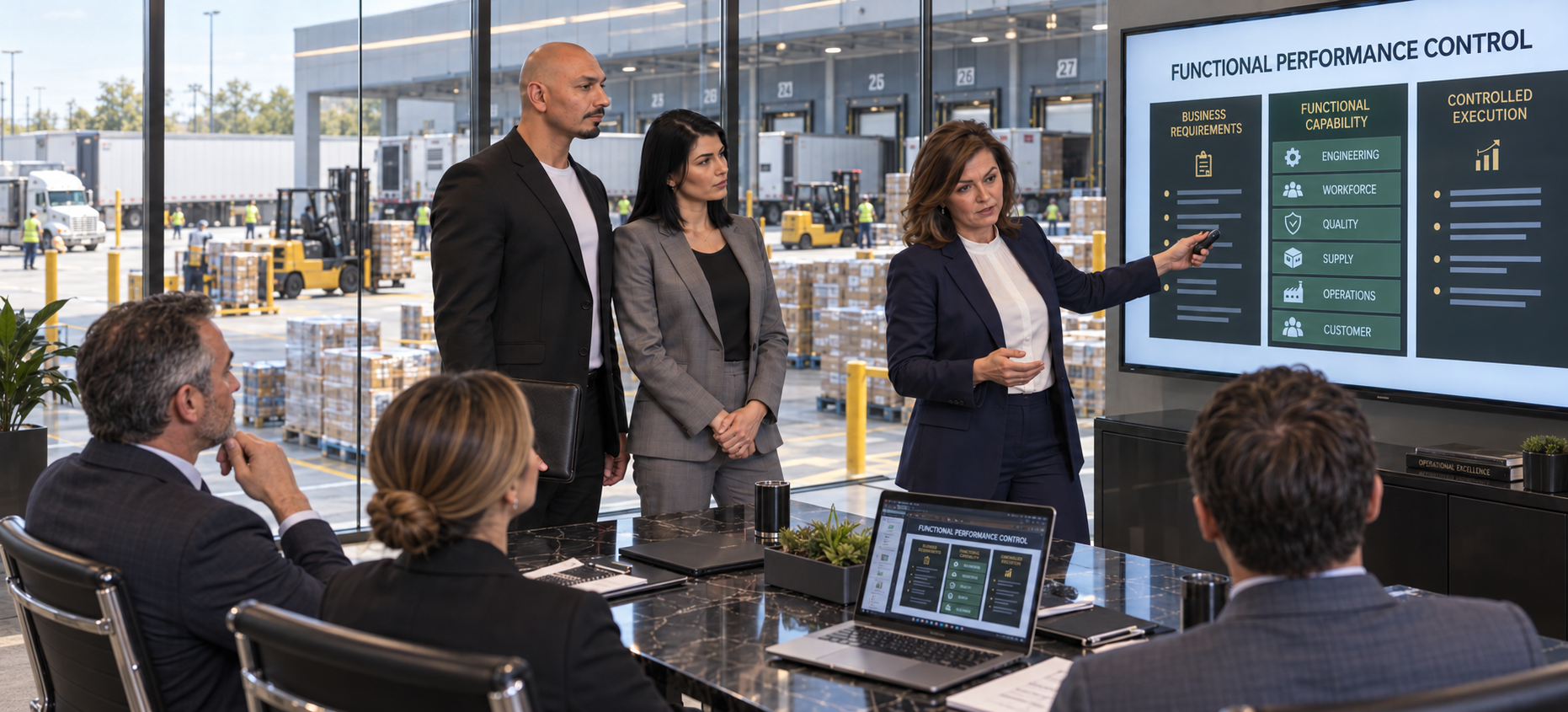
ENGAGE TJEG ON A FUNCTIONAL-LEVEL MATTER
Is a specialized function capable of producing the result the business requires?
The condition may involve functional structure, authority, management systems, professional capability, capacity, cross-functional coordination, process control, performance measures, information integrity, resource requirements, or recurring failures that operating teams cannot resolve through the execution of daily work.
The matter does not need to arrive already diagnosed.
Provide TJEG with the condition as it is being experienced, the available information, the relevant business requirement, the affected functions, known constraints, material decisions, actions already attempted, and the result the organization needs to achieve.
TJEG will determine whether the matter falls within its capabilities, whether Functional Level attention is required, how the condition interacts with the other organizational levels, and where the work should begin.