
CASE STUDIES / OPERATIONAL LEVEL
TJEG CAPABILITY IN PRACTICE
Recovering Operational Control to Retain a Defense Manufacturing Program
Operational Level Case Study | Precision Metal Fabrication and Defense Manufacturing
A precision metal fabricator placed its final effort to retain a principal defense-sector customer under the finishing leadership of TJEG's founder. Inspection established that the customer risk extended beyond finishing into fabrication, quality control, material disposition, external processing, identification, and release. Approximately 200 MRB-controlled parts were processed in less than one month, incoming production was stabilized, the customer was retained, and the program continued across more than 200 lots involving over 30 part configurations.
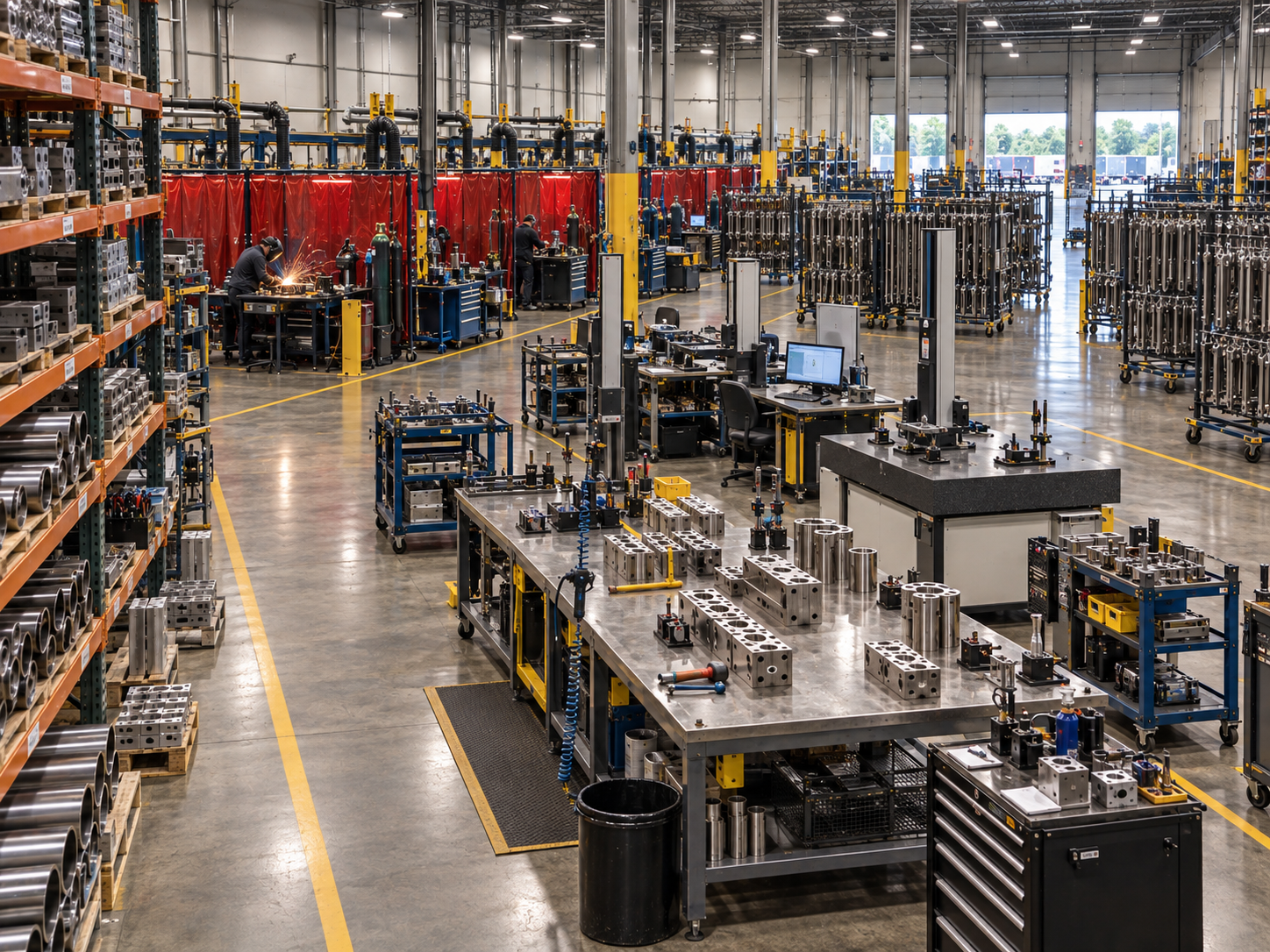
Representative image.
THE OPERATING CONDITION
The program involved more than 30 part configurations, commonly produced in lots of approximately 50 units. Work moved through laser cutting, forming, welding, weld blending, grinding, surface preparation, coating, serialized identification, inspection, packaging, and shipment.
Nonconformities included dimensional and cutting errors, forming deviations, weld distortion, incomplete fillet welds, spatter, excessive material removal, inadequate blending, coating accumulation, insufficient coverage, and missing or incorrect serial numbers.
Approximately 200 parts had accumulated within the Material Review Board process. Management was considering additional storage, but storage would not determine disposition, recover usable material, or interrupt the conditions replenishing the inventory. The accumulated parts were evidence of a wider control failure across production and release.
WHAT TJEG RECOGNIZED
The initial assignment concerned finishing, but direct part inspection and observation of workstations, tool use, and transfers showed that defects originated across several operations. Subsequent lots were advancing toward outside coating with detectable fabrication and workmanship conditions. Continued processing would add transportation, supplier expense, handling, and lead time to parts that might later require coating removal, rework, or scrap disposition.
TJEG's founder advised ownership that finishing could not be corrected in isolation while defective work continued entering and leaving the area. On the fourth day, delegated authority was used to stop the affected finishing activity. The intervention prevented affected finishing work from continuing into further processing while workforce capability and production controls were reconstructed.
THE APPLIED OPERATING RESPONSE
Employees practiced on scrap material before live production resumed. Direct demonstration and supervised execution addressed grinder position, tool control, material-removal rate, weld blending, spatter removal, geometry preservation, and coating readiness. Pace increased only after personnel demonstrated control of the required condition.
Employees who developed the necessary competence received further responsibility. Personnel whose capabilities did not align with the work were reassigned or separated after continued instruction did not produce the required execution.
Responsibility expanded across inspection priorities, MRB recovery, welding and forming coordination, touch-up, outside coating, serialized identification, protective wrapping, job closeout, shipping, receiving, and customer-release preparation. This expansion reflected the evidence: the finishing condition could not be stabilized unless corrective authority followed the product across the complete delivery sequence.
MATERIAL DISPOSITION AND RELEASE CONTROL
Each MRB-controlled part was evaluated according to its physical condition. Recoverable components returned to the operation capable of correcting them. Parts with insufficient weld fill moved through inspection to welding, with repair labor charged to the applicable job. Restored parts could then rejoin compatible quantities of the same part number for external processing.
Parts with unrecoverable distortion, dimensional damage, or excessive material removal received scrap disposition before further labor or supplier expense was committed. Recurring conditions directed corrective attention toward cutting, forming, welding, finishing, inspection, and the transfers among them.
External processors received explicit coating and marking requirements. Returned parts were examined for coverage, thickness, surface condition, serialized identification, and necessary touch-up before protective wrapping and release. Outsourcing a process did not transfer the manufacturer's accountability for the delivered product.
CORRECTING STANDARD TIME AND COST
Existing finishing estimates understated the labor required for compliant workmanship. After the method was stabilized, finishing procedures for each applicable part configuration were timed and recorded across 100 repetitions.
The corrected method produced acceptable work at a faster and more consistent pace, but measured labor content still exceeded the established allowance. The evidence therefore required an increase in standard time and the related finishing cost basis. Accurate standards were necessary for estimating, scheduling, capacity decisions, and performance evaluation.
THE DEMONSTRATED RESULT
Approximately 200 MRB-controlled parts were processed in less than one month through recovery, rework, or scrap disposition appropriate to their condition. Incoming production was stabilized during the same period, and recurring customer rejection eventually became scarce.
The principal customer was retained, and the relationship improved within approximately one month. Customer feedback characterized the resulting workmanship as the best quality received to that point. Assigned production quantities subsequently increased, and the program continued across more than 200 lots involving over 30 part configurations.
These results establish that the intervention did more than reduce stored MRB inventory. It restored operating control across production, disposition, external processing, inspection, and customer release sufficiently to preserve and extend the program.
TJEG CAPABILITY SUBSTANTIATED
This case demonstrates TJEG's capability to trace visible quality failures across their full production system, distinguish recoverable from unrecoverable material, develop workforce competence through direct demonstration, correct inaccurate labor standards, coordinate internal and external processing, and restore release control around customer requirements.
TJEG applies this discipline when unacceptable work continues to advance, held material lacks timely disposition, production standards misrepresent the required work, or customer retention depends upon controlled operational recovery.
HISTORICAL ATTRIBUTION
TJEG Applied Experience: This case reflects prior operational leadership experience incorporated into TJEG's consulting capabilities.
RELATED CAPABILITY
-
Examine how TJEG connects leadership conduct, workforce feedback, operating constraints, technical instruction, workforce placement, and corrective response to the conditions that determine whether required performance can be achieved and sustained.
DISCUSS AN OPERATIONAL-LEVEL MATTER
If your organization needs to examine persistent quality failures, material held for disposition, inaccurate production standards, or customer-release risk, contact TJEG to discuss the operating circumstances and support required.