
CASE STUDIES / OPERATIONAL LEVEL
TJEG CAPABILITY IN PRACTICE
Reconstructing High-Mix Cable Production to Release Latent Operating Capacity
Operational Level Case Study | Specialized Wire and Cable Prep Manufacturing
TJEG's founder reconstructed a high-mix production system that typically completed approximately 50,000 to 60,000 units per week. By reorganizing work, creating purpose-built fixtures, controlling changeovers, and using existing equipment in parallel, the operation completed approximately 100,000 mixed units in one 10-hour demonstration. The result exceeded the committed objective by 100 percent and the former weekly output by approximately 67 to 100 percent.
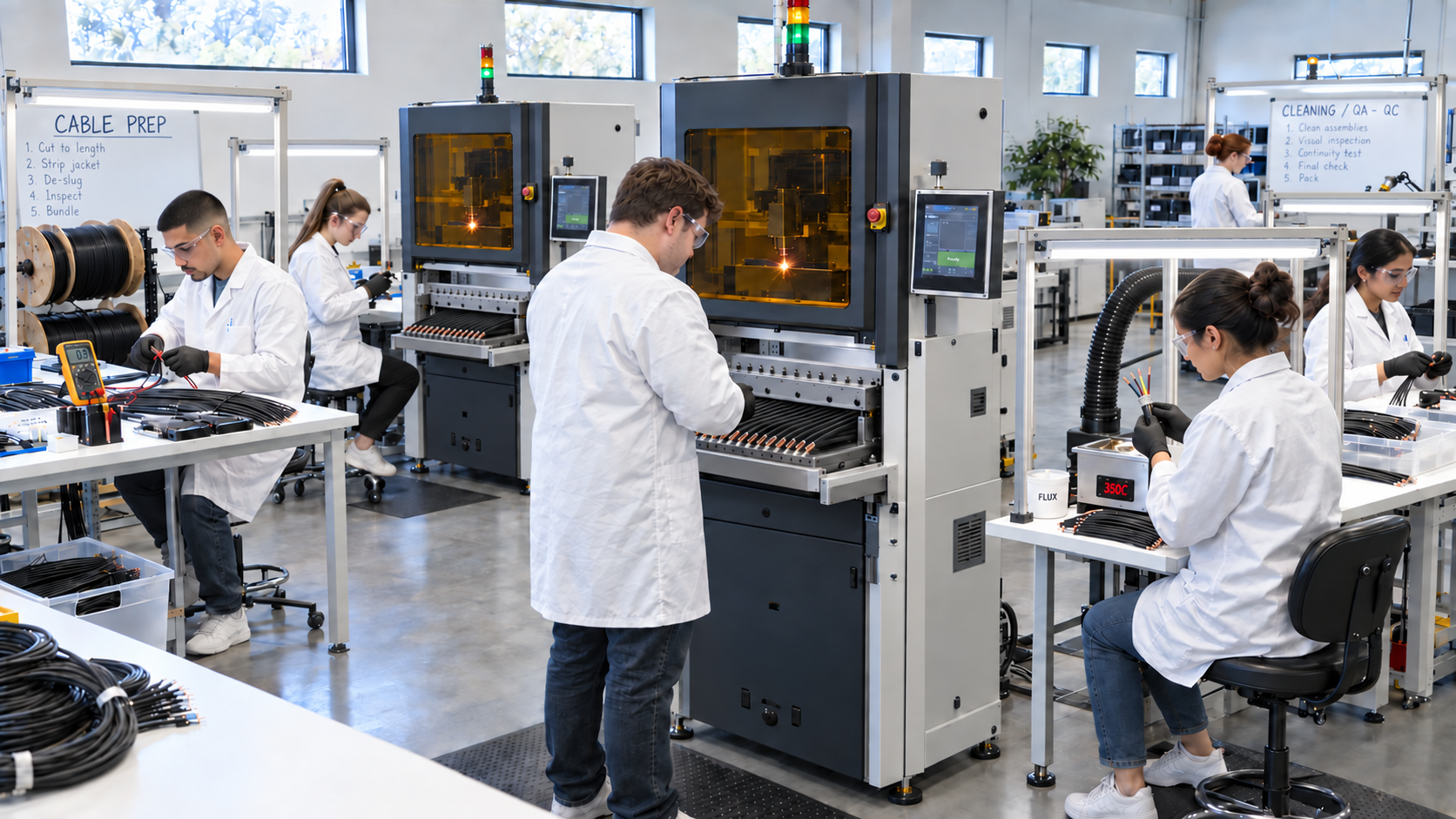
Representative image.
THE OPERATING CONDITION
The manufacturer produced wires and cables across different gauges, dimensions, lengths, jacket configurations, processing requirements, and quantities. Individual jobs ranged from approximately 1,000 to 50,000 units. Although product complexity varied, material generally moved through spool selection, dimensional cutting, laser processing, jacket removal, conductor exposure, soldering, inspection, packaging, and shipment.
Employees typically followed individual jobs through successive stages. This maintained activity but fragmented attention, left specialized stations intermittently unoccupied, repeated positioning and setup interpretation, and organized production around individual job ownership rather than continuous movement of the complete workload.
The apparent capacity limit was therefore not established by the available labor or equipment. It was produced by the operating architecture through which those resources were coordinated.
WHAT TJEG RECOGNIZED
TJEG's founder performed and timed the complete production sequence under controlled conditions at a deliberate, sustainable pace. The trial showed that substantially greater output was possible when each stage operated as part of one production system.
A formal demonstration was then structured around a representative mixture of gauges, order quantities, tooling requirements, and processing complexity. This prevented one unusually simple product from determining the result and tested whether the redesigned system could govern the work the company routinely produced.
THE OPERATING RECONSTRUCTION
Employees received defined station responsibility while material advanced through the sequence. Cross-training preserved absence coverage and workforce flexibility without returning the operation to fragmented job ownership.
Production priorities incorporated customer requirements, processing burden, machine availability, soldering demand, and the ability to complete and ship an order within the operating day. This prevented partially processed volume from being treated as equivalent to customer-ready output.
A green control card accompanied the final production group within each job and initiated the transition to the next work package. The incoming package identified the required tooling, fixtures, and machine program. Operators verified upper and lower laser alignment and processed a representative sample to evaluate cut depth, conductor exposure, material response, power, speed, and lens condition before releasing production.
These controls allowed the operation to increase movement without separating production pace from workmanship verification.
FIXTURE DEVELOPMENT AND PARALLEL CAPACITY
Fine-gauge wires, including approximately 32-gauge wire and smaller, had been positioned and cut individually. TJEG's founder created purpose-built fixtures that held multiple wires as a controlled group. Grooved surfaces maintained separation and alignment, a low-tack surface retained position without preventing removal, and a defined processing window exposed the jacket area requiring laser treatment.
The fixtures reduced repeated handling, stabilized material presentation, and created a smoother transition through cutting, laser processing, jacket removal, and subsequent operations. Small-gauge wire could also be processed on the larger laser system while cable work continued through another production path. Grouped processing and parallel routing therefore expanded the productive use of existing equipment without requiring additional production machinery.
THE DEMONSTRATED RESULT
The 10-hour demonstration carried a committed objective of 50,000 completed mixed units, approximately equivalent to the company's previous weekly output. About 40,000 units had been completed after approximately four hours.
As multiple jobs reached completion, the company's CEO measured and tested sampled units, examined processing condition, and confirmed completed quantities against the production objective. By the end of the demonstration, approximately 100,000 mixed wires and cables had been completed.
The reconstructed system exceeded the committed objective by 100 percent. Its one-day output exceeded the former weekly range of approximately 50,000 to 60,000 units by approximately 67 to 100 percent, producing approximately 40,000 to 50,000 more completed units than the operation had previously completed during an entire week.
The evidence established that the former output level was not the productive limit of the existing equipment. Capacity had remained concealed within work assignment, tooling, machine allocation, changeover control, and production sequencing.
BUSINESS CONSEQUENCE
The demonstrated capacity exceeded the company's booked workload, moving the governing constraint from production toward commercial demand. A prospective customer awaiting capacity was expected to introduce approximately 50,000 to 100,000 additional units per week.
The demonstration also produced a workforce agreement under which employees could receive the remainder of the week away with pay when available work was completed early. The operating improvement therefore connected employee benefit, customer capacity, and the company's requirement to secure additional business.
TJEG CAPABILITY SUBSTANTIATED
This case demonstrates TJEG's capability to identify capacity concealed by production design and release it through coordinated changes to labor deployment, equipment use, purpose-built tooling, process information, quality verification, changeovers, and shipment priorities.
TJEG applies this analysis when an organization must determine whether a visible capacity limitation is physical, technical, organizational, informational, or created by the method through which existing resources are governed.
HISTORICAL ATTRIBUTION
TJEG Applied Experience: This case reflects prior operational leadership experience incorporated into TJEG's consulting capabilities.

RELATED CAPABILITY
-
Examine how TJEG connects leadership example, production design, workforce development, cross-training, and management accountability to establish an operating culture capable of sustaining controlled flow, workmanship, and customer execution.
DISCUSS AN OPERATIONAL-LEVEL MATTER
If your organization needs to examine a production constraint, recurring quality condition, or delivery problem, contact TJEG to discuss the operating circumstances and support required.