
CASE STUDIES / OPERATIONAL LEVEL
TJEG CAPABILITY IN PRACTICE
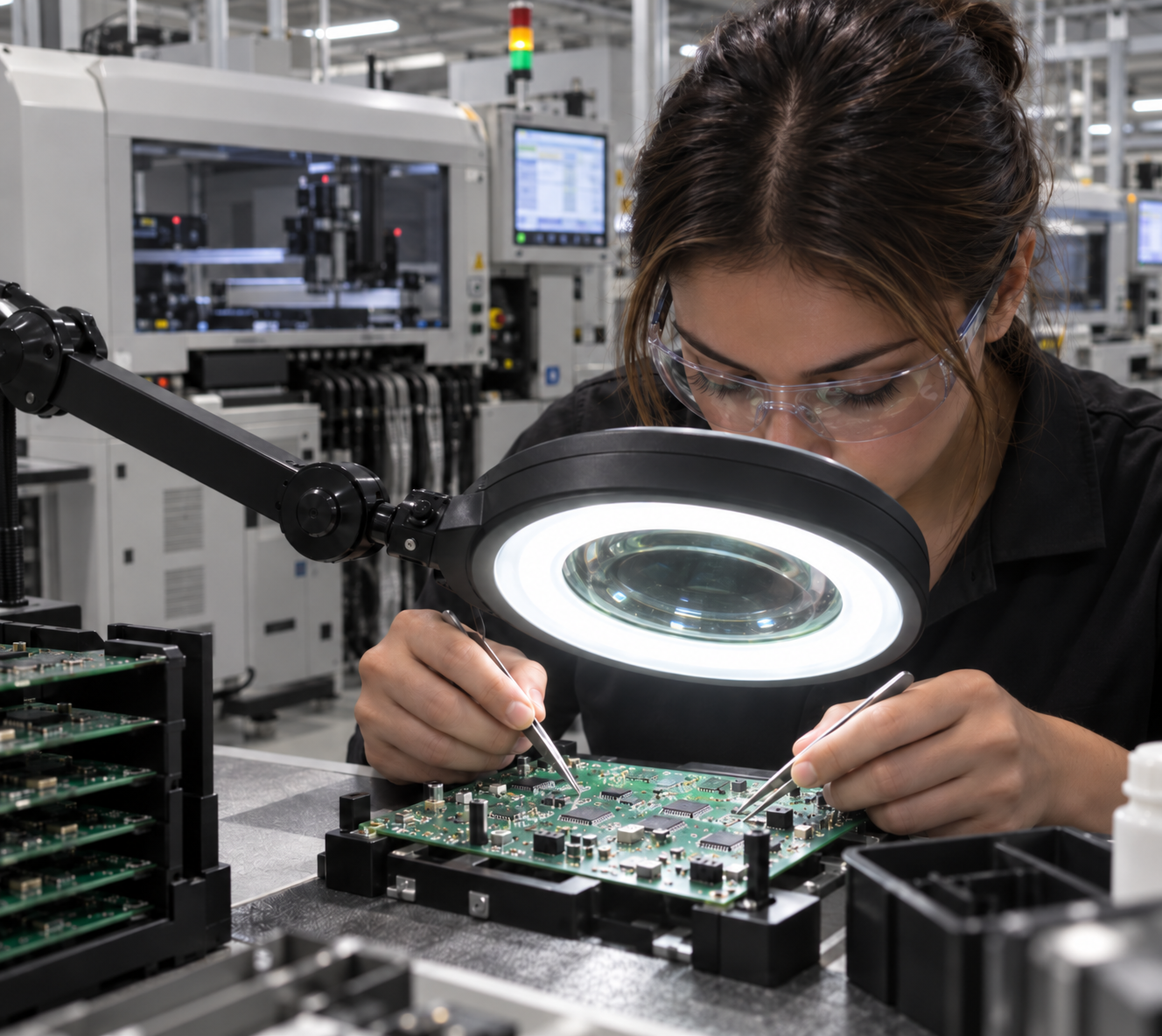
Representative image.
Capturing the Benefits of Robotics Through Engineering Control and Human Accountability
Operational Level Applied Experience Synthesis | Robotic Welding and Automated Electronics Manufacturing
Across robotic welding and automated circuit-card assembly, TJEG’s founder observed the same operating relationship: automation created substantial value by executing programmed work repeatedly at a speed manual processing could not reproduce. Although such equipment is often described as autonomous, its independence remained bounded by human control of the conditions surrounding it.
People remained accountable for program accuracy, output conformance, and the decision to continue production. Automation changed the content of human work; it did not eliminate responsibility for production outcomes.
THE OPERATING ENVIRONMENTS
In precision fabrication, robotic equipment completed multiple weld joints by reproducing a programmed path across successive units. This reduced manual welding and supported consistent execution when the program and operating conditions were correct.
In electronics manufacturing, circuit cards advanced through a sequential automated line using surface-mount component-placement equipment. Boards were loaded, solder paste was applied, and the machines positioned more than 200 programmed components before reflow. Manual assembly could not match the line’s production rate.
Both systems concentrated production capability within their programming, setup, material presentation, equipment condition, and inspection controls. Repetition could produce conformity or multiply error.
WHAT TJEG RECOGNIZES
Automation is most useful when work has repeatable geometry, stable inputs, defined acceptance requirements, and sufficient volume. Under those conditions, it can improve speed, repeatability, process continuity, and the use of skilled labor.
The machine operates within the logic, tolerances, sensing capability, tooling, maintenance condition, and exception rules designed into the system. Robotic welding remains constrained by joint geometry, fit-up, part location, access, weld path, travel speed, and heat input. Automated component placement depends upon board registration, feeder setup, component data, placement coordinates, solder-paste condition, and reflow control. An error in these conditions can be reproduced faster than in a manual process.
Human accountability must surround the automated cycle. Engineering controls technical logic; operators monitor production conditions; inspectors evaluate conformance; maintenance preserves equipment capability; and management controls release, escalation, corrective routing, and stop-work authority.
ROBOTIC WELDING AND CORRECTIVE ESCALATION
Robotic welding reduced manual joint completion and provided a repeatable method for executing programmed weld paths. Inspection of completed welds remained the governing control.
TJEG’s founder trained personnel to distinguish an isolated defect from a recurring condition. An isolated discontinuity could receive controlled retouch when technically permissible. When the same defect recurred at the same location or followed a consistent pattern, further retouch did not address its source. Engineering needed to examine the program, weld path, parameters, joint access, or another controlled input.
Operators and inspectors communicated recurring defects to Engineering instead of repeatedly passing the same programmed error into rework. Their feedback converted physical evidence into information capable of correcting the automated process and reducing further defect generation.
AUTOMATED COMPONENT PLACEMENT AND INSPECTION CONTROL
Correct programming allowed placement equipment to install more than 200 components at a rate manual placement could not sustain. Incorrect placement logic could stop production or reproduce the same positional error across successive boards.
TJEG’s founder inspected circuit cards under magnification before reflow, examining component presence, position, orientation, and visible assembly condition before heat fixed the components in place. Detection at this point prevented a known defective board from advancing and preserved a controllable correction opportunity.
Post-reflow inspection confirmed whether components remained correctly positioned and whether the thermal process produced an acceptable assembly. The two inspections controlled different failure opportunities on opposite sides of an irreversible production transition.
THE DEMONSTRATED OPERATING RELATIONSHIP
Across both environments, automation produced its strongest benefit when human work addressed the machine’s limitations. Personnel supplied the judgment the equipment did not possess: recognizing abnormal output, interpreting recurrence, distinguishing retouch from program correction, protecting release points, and directing evidence to the function authorized to change the system.
The result was a more disciplined relationship among automated execution, inspection, rework, and engineering response. In robotic welding, recurring defects were redirected toward program-level investigation, reducing repeated rework. In circuit-card assembly, pre-reflow inspection stopped observed placement errors from advancing, while post-reflow inspection verified the completed assembly.
BUSINESS CONSEQUENCE
The commercial value of automation depends upon more than machine cycle time. The organization must also control defect multiplication, downtime, rework, material exposure, technical escalation, and the availability of personnel capable of interpreting the output.
Well-governed automation reallocates labor toward higher-consequence work while preserving throughput. Poorly governed automation can accelerate cost because the repeatability that produces conforming units can reproduce an incorrect condition across an entire production quantity.
TJEG CAPABILITY SUBSTANTIATED
This synthesis demonstrates TJEG’s capability to evaluate automated production as an integrated operating system rather than an equipment purchase or labor-replacement exercise. The relevant analysis connects programming, engineering authority, operator competence, inspection timing, maintenance, rework routing, material flow, and production release.
TJEG applies this perspective when an organization must determine where automation can create legitimate operating advantage, which engineering constraints govern that advantage, and what human responsibilities must remain explicit for performance to be safe, controlled, and economically defensible.
HISTORICAL ATTRIBUTION
TJEG Applied Experience: This synthesis reflects prior operational and technical experience incorporated into TJEG’s consulting capabilities.
RELATED CAPABILITY
-
Examine how leadership conduct, workforce feedback, technical instruction, workforce placement, and corrective response determine whether required performance becomes executable, credible, and sustainable.
DISCUSS AN OPERATIONAL-LEVEL MATTER
If your organization needs to evaluate robotics, automated production, inspection controls, engineering escalation, operator capability, or recurring rework, contact TJEG to discuss the operating circumstances and the support required.