
FOUR LEVELS OF BUSINESS

Every Level of an Organization Carries a Different Responsibility.
Performance Depends on How Well They Work Together.
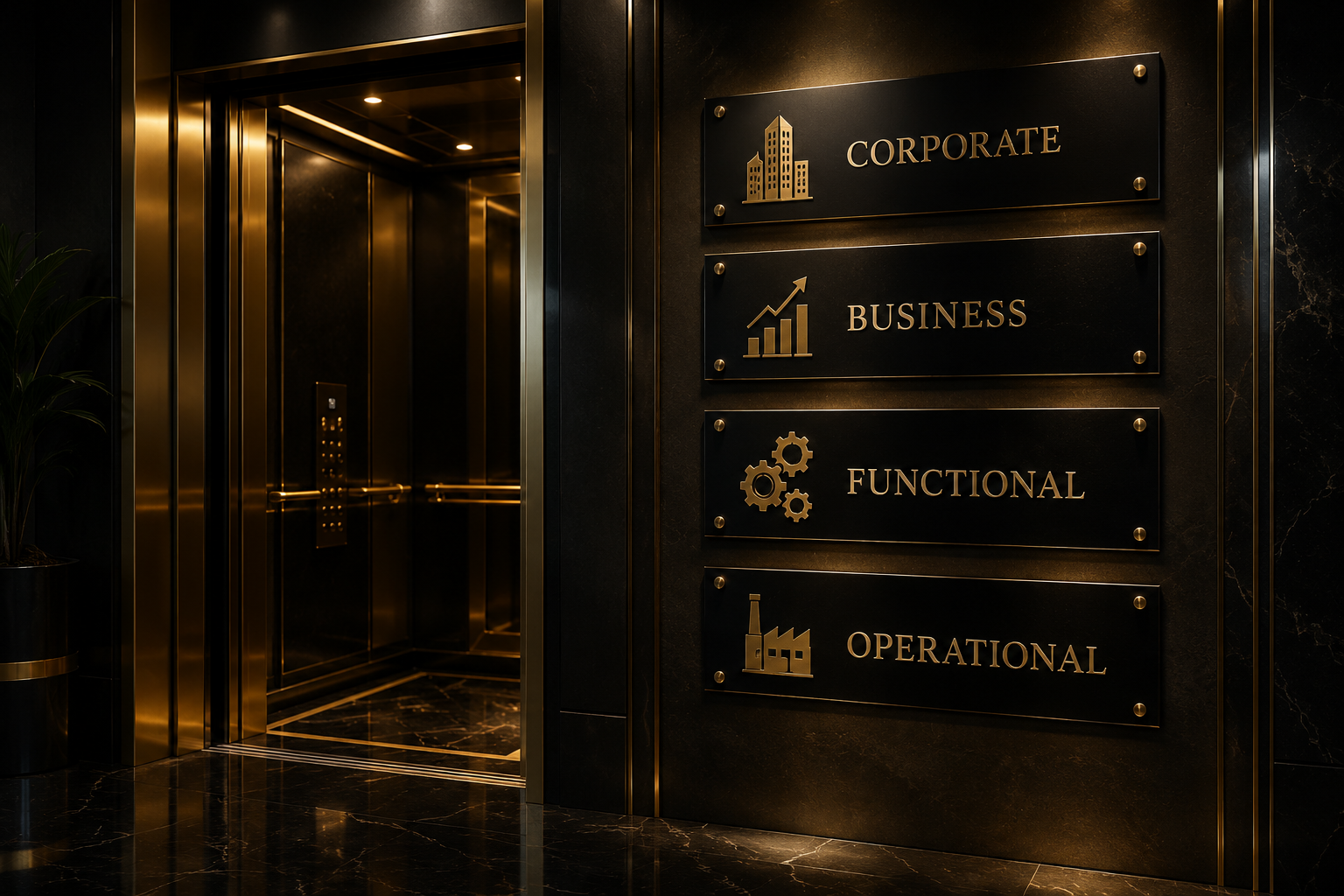
Corporate leadership establishes enterprise direction. The business must convert that direction into a viable and competitive organization. Functions must provide the specialized capabilities required to support it. Operations must execute the work.
When these levels are aligned, decisions move, responsibilities are understood, functions support the requirement, and execution follows direction. When they are not, problems can move across organizational boundaries.
TJEG examines organizations across four distinct but interconnected levels to determine where responsibility belongs, where performance is being affected, and where management action may be required.
CORPORATE
Where enterprise direction, authority, and organization-wide decisions are established.
The Corporate Level governs the organization as a whole. It establishes enterprise direction, decision authority, organizational structure, leadership accountability, major priorities, and the allocation of resources across the enterprise.
Governance · Enterprise Direction · Executive Leadership · Organizational Structure · Long-Term Priorities · Enterprise Performance · Transformation
BUSINESS
Where the organization determines how it will compete, grow, generate value, and perform.
The Business Level determines how the organization creates value, competes, grows, and performs. It connects enterprise direction to the business model, customers, markets, revenue, competitive position, growth requirements, and the management infrastructure required to support performance.
Business Model · Customers · Markets · Revenue · Growth · Competitive Position · Business Performance · Organizational Alignment
FUNCTIONAL
Where specialized capabilities must perform individually and coordinate collectively.
The Functional Level brings together the specialized capabilities the organization depends on to perform. Operations, manufacturing, quality, supply chain, procurement, human resources, sales, finance, technology, and other functions each carry distinct responsibilities, but none operate in isolation.
Each function may have its own responsibilities, objectives, processes, and expertise, but organizational performance depends on how effectively those functions support the wider business and coordinate where their responsibilities intersect.
Operations · Manufacturing · Quality · Supply Chain · Procurement · Human Resources · Sales · Finance · Technology · Engineering Coordination
OPERATIONAL
Where plans, resources, processes, and management decisions become actual work.
The Operational Level is where the organization has to deliver. This is where workflow moves, products are produced, services are delivered, standards are followed, processes are controlled, capacity is used, and management decisions encounter operating reality.
Performance at this level depends not only on the people executing the work, but also on the systems, resources, information, priorities, processes, and decisions supporting them.
Workflow · Production · Standard Work · Process Control · Capacity · Productivity · Resource Utilization · Performance · Continuous Improvement
THE LEVEL WHERE A PROBLEM APPEARS MAY NOT BE THE LEVEL CAUSING IT
A production problem is not automatically a production problem.
A production constraint may first become visible at the Operational Level, while the contributing condition exists somewhere else.
At the Functional Level, the issue may involve scheduling, quality, procurement, staffing, maintenance, engineering coordination, or material availability.
At the Business Level, demand, growth, customer commitments, pricing, or capacity requirements may be placing demands on the organization that its existing systems cannot support.
At the Corporate Level, leadership may ultimately need to address enterprise structure, resource allocation, capital requirements, authority, or another organization-wide decision.
The visible failure identifies where the problem was discovered. It does not necessarily identify where the problem must be corrected.
HOW TJEG USES THE FOUR LEVELS
The objective is not to assign every problem to a box. It is to determine where action belongs.
TJEG may begin at the level where the requirement first becomes visible and examine other levels when the evidence indicates that the condition extends beyond its apparent point of origin.
WHERE IS THE CONDITION VISIBLE?
Identify where performance is being affected.
WHERE DOES RESPONSIBILITY SIT?
Determine who owns the process, function, decision, or result.
WHERE DOES AUTHORITY EXIST?
Determine who can authorize the required action.
WHERE DOES THE CAUSE ORIGINATE?
Establish whether the visible failure is being produced somewhere else.
WHERE DO THE CONSEQUENCES EXTEND?
Determine what other functions, levels, customers, resources, or objectives are affected.
WHERE IS ACTION REQUIRED?
Establish where management intervention is required for the correction to hold.
ENGAGE TJEG FOR YOUR NEXT STRATEGIC DIRECTION
Is the Organization Addressing the Problem at the Level Where It Can Actually Be Corrected?
A condition may be visible in one area, owned by another function, influenced by business priorities, and ultimately require action from executive leadership.
The matter does not need to arrive already classified.
Bring TJEG the condition, available information, known constraints, affected areas, and the result leadership needs to achieve. TJEG will determine where the matter sits within the organization, whether it extends across multiple levels, and where further investigation or management action should begin.